
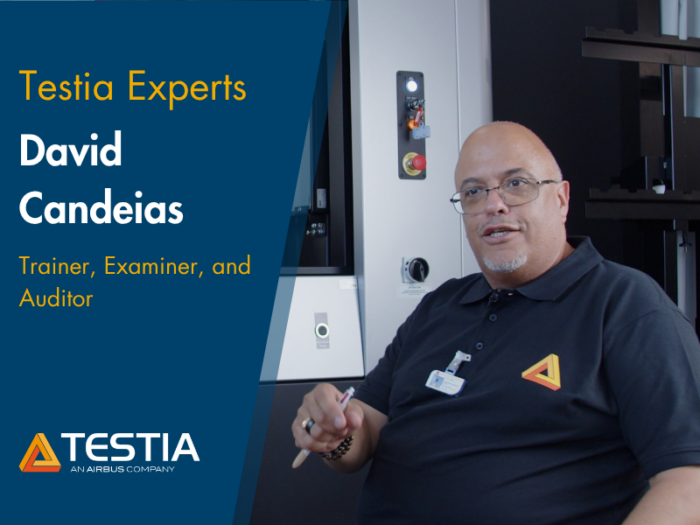
In our article series « Testia Experts », we present short interviews with our employees – the experts that really make Testia what it is. In this issue we speak with David Candeias, NDT instructor, examiner, and auditor at Testia.
You can also watch this video interview on YouTube.
 Can you introduce yourself and your career path at Testia?
My name is David CANDEIAS. Today at Testia, I am an instructor, examiner and also an auditor.
Before that, at Testia, I started at the expertise workshop, where we inspect parts that come from planes. These are often maintenance parts, meaning that we receive parts dismantled from the aircraft and we inspect them directly in the workshop.
I had a small team, up to 15 people, and it is actually at that moment that I developed a passion for teaching. I was training new joiners, who then evolved, who passed their Level 1, Level 2 and then Level 3 qualifications. This really is a source of pride when you train people who are then able to go up to that level. To me, it was a logical transition: Moving from the workshop to the training center.
Today at Testia, I teach radiography (RT) but also penetrant testing (PT) and magnetic particle testing (MT). I deliver training courses mainly in French, with a particularity: I also deliver training courses in Portuguese.
You started as a NDT technician, is that the case for all instructors?
Let’s say that it is a logical next step. As a technician, you are much more likely to be able to understand the challenges that the trainees are facing in their daily lives, since you have been facing similar challenges yourself. This is definitely a strength to have experienced what the trainees simply live, also because sometimes there are gaps between theory and practice.
Someone who does not come from the field will become very attached to theory and not to practice in the field, meaning that he will have a hard time admitting that sometimes, things just do not go as expected. And inevitably, if the trainees happen to realize that what you are saying does not match the reality, you lose them. So having someone who comes from the field, who has experienced these things, will have a stronger impact and therefore will be able to find the right words to get them involved.
However, during the Covid period we happened to bring some external members to our team. This was actually to avoid laying off people. So we trained people who did not have any technical background but who were good educators. Pedagogy is an essential quality for trainers. Aeronautics and technology can be learned, pedagogy can be improved, but you need to have a little bit of a flair for teaching to become an instructor.
So out of these people, there were two in this case, who had this capacity. We taught them the technique, we taught them avionics and they held their own training sessions, after which the trainees were very happy. They did not notice at all that they lacked technique.
So yes, being a technician is a plus. But there are some cases where, with a lot of work, it is possible to get over it.
You hold Level 3 qualifications in RT, PT, and MT. What does that entail in terms of daily requirements and responsibilities?
There are a lot of requirements, a lot of responsibilities too but not all Level 3s have the same degrees of requirement and responsibility. It all depends on their activities within the companies.
Today, my Level 3 activities at Testia are mainly focused on radiography. I also work with external companies, for which I act as their responsible Level 3, which means that I cover all the methods and techniques they need. So I deal with the technical side but also some documentation management, and document validation. This is a big responsibility because all the documentation needed to release a part, including the control instruction that the inspectors use to inspect the part and generate the corresponding report, must be validated by a Level 3 before the part is sent back to the customer. This requires a certain level of organization.
When we are dealing with parts that come up regularly, we can work with the same documentation. On the other hand, when we deal with what we call a “first article”, when it is the first time that we receive a specific part, then it is absolutely necessary to get the instruction validated, to ensure that at any given moment, there has not been any mistake, or any lack of control or any misinterpretation of the documentation. We need to check everything.
We also take care of the validation of the general control procedures, everything that encompasses the entire process of how the machine should be used and how the inspections should be performed. The higher your qualification level is, the higher your responsibilities are.
In fact, Level 1’s responsibilities involve being able to follow a control instruction from A to Z. The Level 2 is the one who writes it and the Level 3 is the one who supervises and validates all the documentation and the entire process.
So yes, being a Level 3 involves many responsibilities. And as a Level 3, you can also be required to be an examiner, which is yet another step. This is a quite heavy responsibility since it implies allowing candidates to perform critical inspections. The stake is therefore very high because if you ever deliver a qualification to someone who does not meet the requirements this can potentially lead to critical errors on the field.
Our job is to make flying safe. We are part of the flight safety chain, so it is very important. It is partly thanks to us that, today, there are fewer and fewer planes crashing. So if we suspect even the slightest risk, we cannot take the risk to certify a candidate. In such cases, we need to demonstrate things that the candidate has done or has not done during the exam day to justify the failure of the exam. It is quite a big responsibility. And afterwards, we also need to justify it to the candidate, by simply explaining why he failed, so he can improve in the future.
In the end, as examiners, we are constantly evolving: whether we hold a Level 1, Level 2 or Level 3. Every five years we need to retake each exam. It is basically a perpetual process of self-reflection.
The EN 4179 and NAS 410 standards are extremely strict. How do you prepare future inspectors to meet these high standards?
We have some basics, which are the training materials that will simply prepare the trainees to take the exam in accordance with the EN 4179 standard.
We also have our internal certification management, which is constantly evolving because the standards are evolving. As Level 3s, we usually receive alerts on the evolution of the CER-FrNDTB, which is the French national board for everything related to aeronautics. Generally, they apply changes to reflect changes to the EN standard. So for us, it involves a double check: we check that we are compliant with the national board but also with the EN 4179 standard.
The training itself is usually not impacted much by these changes, but we need to take them into consideration when preparing the candidates for the exam, explaining what has changed so that they are as well informed as possible about what they are expected to know.
Additionally, because Testia is a transnational company, we need to comply with international standards as well. For example, the EN 4179 standard is for Europe while the NAS410 is for America.
After 10 years of experience, what still excites you so much about your role at Testia?
The joy of passing on knowledge. When you see people you trained evolving, within their company or even internally, it is a source of pride in some way. When you train people who do not know the method at all and then you see them again seven years later, they have become Level 3s, they are responsible in their company for the entire NDT division… It is really nice.
Beyond that, we teach them the know-how, the specific nature of the profession. The how to carry out the tasks correctly, and avoid drifts. I am also an auditor, so when I go to audit companies, I quickly notice that people are deviating from the process. We have to be aware of it, but we also have to explain the impact of these abuses to people, instead of just blaming them.
Coming from the field, I know where people often drift, because what you learn in theory does not always necessarily work on the field. So you need to adapt and sometimes you are tempted to do things that are not necessarily good. In that case, we simply have to step back, refocus and ask: “What are you doing? You are doing a flight safety inspection. If you ever start drifting, what is the risk?”
Our role is also to remind them of that. And in the end, they drift less and less. That is to say that teaching people the know-how, the heart of the job and the why and how is extremely important, it simply avoids deviations.
Do you have an anecdote or a nice success story about a trainee?
I had an intern who joined us on a work-study basis. At the end of his work-study program he was hired by us in the workshop, he passed his Level 2 directly after. Today, he is a Level 3 at Saint-Eloi, at Airbus. I trained this young man and I saw him grow up. For me, it is a source of pride. And there are many more!
I also remember an intern to whom I delivered her very first training course in France. She is Portuguese and was working in Portugal at that time but the training was supposed to be delivered in French. That being said, her company and I decided to surprise her and in the end I delivered the training in Portuguese. This was about ten years ago and in the meantime she passed her Level 2 and then her Level 3. Today, she speaks French fluently and she is working as a Level 3 in Montauban in France. So for someone who did not speak French, that is pretty impressive…
Watch the video interview YouTube

Thanks for taking the time for this interview!
Are you interested in also becoming a Testia expert? Visit our Career page to find out about our current job offers!