
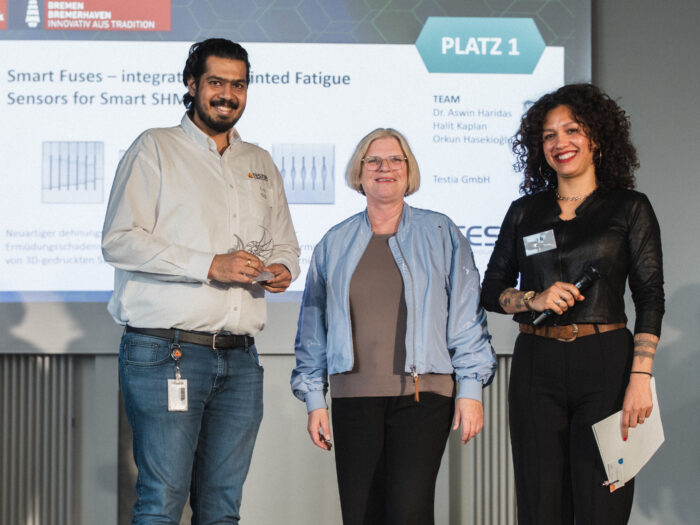
Last month, for the third consecutive year, the Bremen Prize for 3D Printing was held at the ECOMAT research and technology center in Bremen. Our Testia entity in Bremen took part in this competition, along with our partner ATPHARMA LLC, and won the award for the “Innovative Materials or Processes” category with their project “Smart Fuses – integrated 3D-Printed Fatigue Sensors for Smart SHM”!
About Bre3D Award
The award recognizes outstanding practical examples from Bremen’s research and industry sectors, as well as innovative ideas and visions related to 3D printing. It is presented by the Senator for Economic Affairs, Ports and Transformation in collaboration with WFB Wirtschaftsförderung Bremen GmbH.
As part of the competition, a panel of experts selected the winners from 23 exciting submissions received across six categories. The submitted projects ranged from research approaches to new materials, structures and printing processes to concrete industrial applications as well as to practical and design-oriented everyday products.
The Vision Behind the Innovation
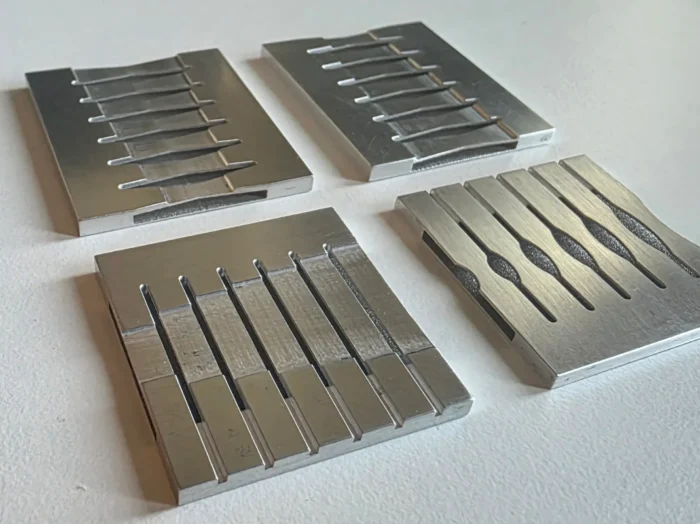
To bring this “Smart Fuses” concept to life, our SHM expert Dr. Aswin Haridas worked closely with ATPHARMA LLC (based in Cambridge, MA, USA) – specifically Dr. Halit Kaplan and Dr. Orkun Hasekioglu – using their advanced sensors and 3D printing them directly with the structures themselves.
Why is this concept revolutionary?
- In-situ integration: By incorporating the sensors within the manufacturing process, the structure becomes inherently “smart” from day one.
- Condition-based assessment: They provide actionable data to optimize maintenance schedules, ensuring the highest level of quality and safety.
- Predictive maintenance: These “Smart Fuses” are able to monitor fatigue in real time, enabling precise rest-of-life estimation.
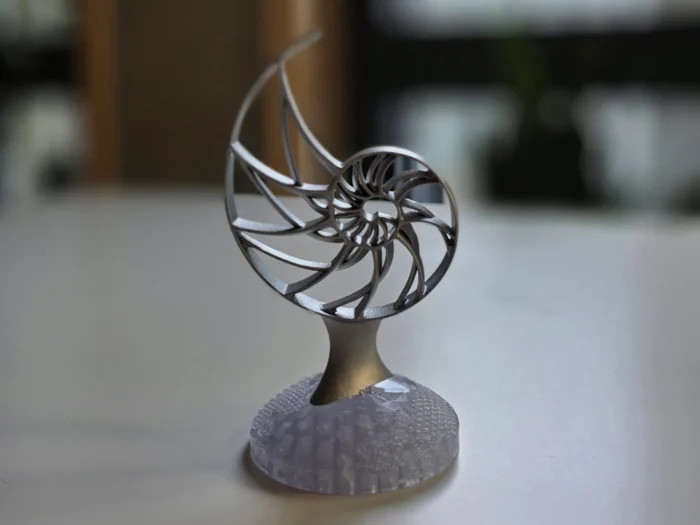 This recognition from the WFB highlights our role as a true hub for aerospace innovation.
By turning structures into self-monitoring assets, this innovation elevates professional competence in Structural Health Monitoring (SHM) to a whole new level.
A huge thank you to the jury for their time and expertise as well as Dr. Halit Kaplan, Dr. Orkun Hasekioglu and Dr. Aswin Haridas for this successful collaboration.
We are looking forward to seeing how this innovation can improve safety in the industry!