
TOULOUSE, France – Testia, an Airbus company, is celebrating its 35th anniversary. The company was founded in 1991 by Airbus predecessor Aérospatiale alongside testing, inspection, and certification provider Bureau Veritas and aerospace pioneer Sogerma. The three partners were united by a shared goal: to rethink aerospace inspection from multiple perspectives.
“Thirty-five years ago, Testia started in France with just 11 pioneers. Today, we are more than 600 people working together across 18 locations worldwide,” says Emmanuel Bodin, who took over as CEO of Testia in mid-2026. “Our expansion has always been guided by the same core mission: to be Aerospace Inspection Experts for keeping aircraft flying safely.”
This end-to-end vision was a deliberate departure from the market standards of the early 1990s. “When we started operations in 1991, most providers focused on just one piece of the puzzle — offering standalone training courses or executing isolated inspection tasks,” recalls Didier Simonet, who has accompanied the company’s evolution since its inception. “From the very beginning, our ambition was different: to break down those silos and support our clients across their entire operational lifecycle.”
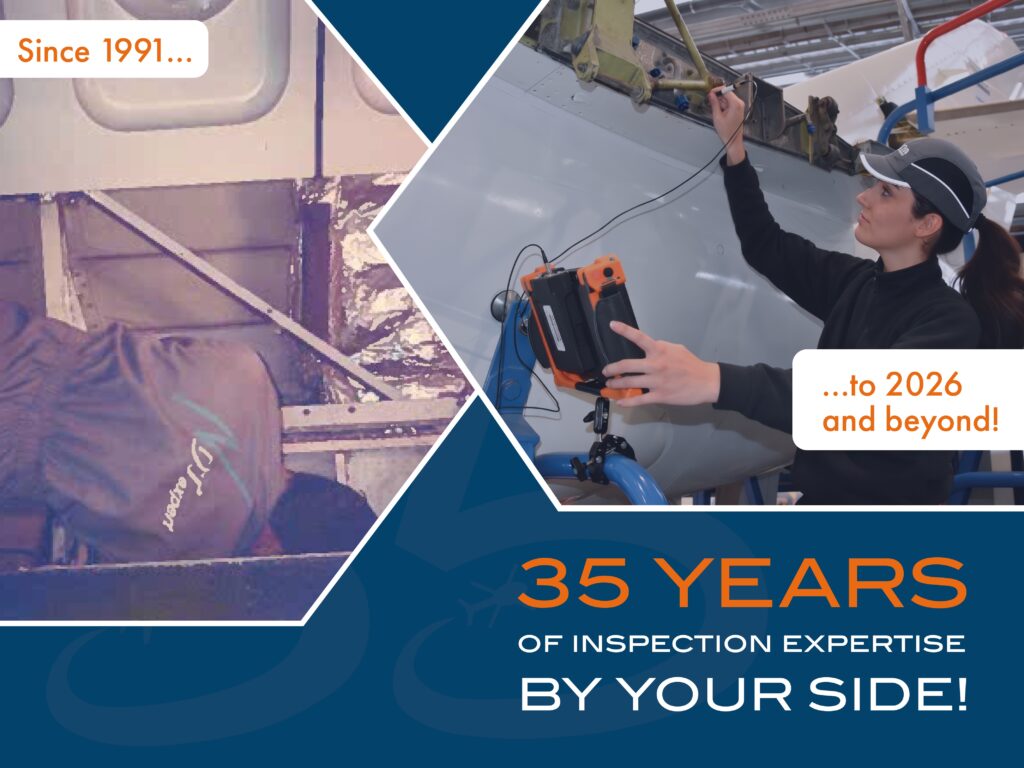
Over the past three and a half decades, that initial ambition has guided Testia’s evolution into an integrated partner across the aerospace value chain — connecting workforce qualification, manufacturing and in-service inspection, engineering consultancy, proprietary hardware and software development, and complete equipment fleet management.”
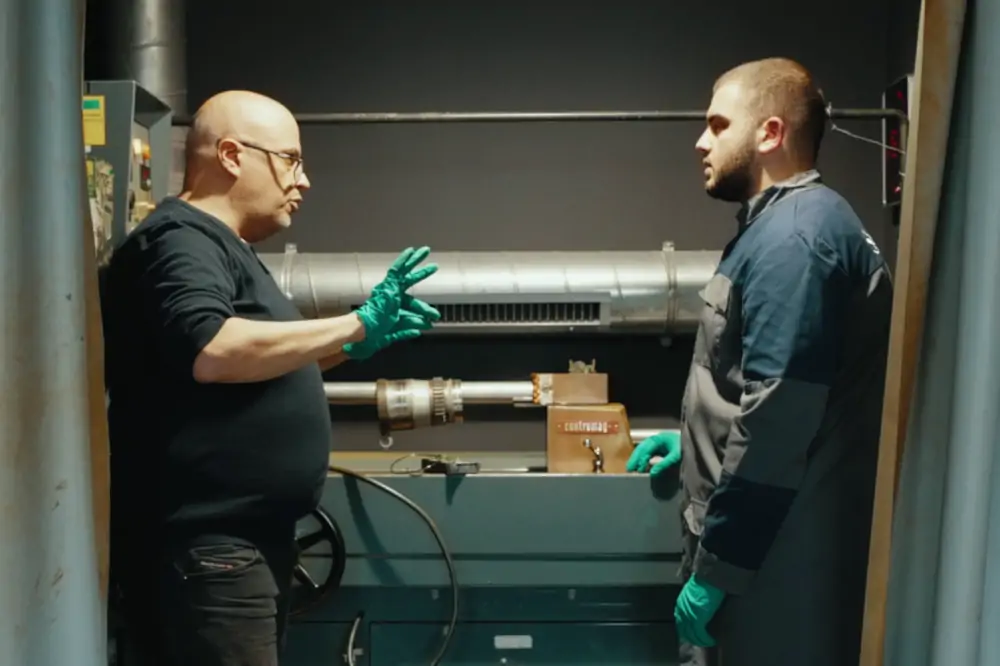
Enabling the industry to master present and future inspection challenges
From the outset, supporting clients end-to-end meant more than executing inspections on their behalf. It meant helping clients build their own internal testing capabilities. “Delivering inspections on site solves an immediate operational need, but long-term capability requires qualified personnel on the customer’s side as well,” explains Fabrice Quarante, Testia’s global Head of Training. “That is why training and qualifying inspection teams was an essential part of our service scope right from the beginning.”
Following this vision, Testia has continuously expanded its network of certified training centers over the past 35 years. To date, the company operates six training centers across Europe, the Americas, and Asia-Pacific, training and certifying more than 25,000 NDT inspectors across the entire sector – from Airbus commercial, helicopter, and space divisions to Tier-1 suppliers and global operators.
Beyond standard course delivery, the focus has always been on adapting qualification pathways to practical needs. “As a training provider, our role is to align strict regulatory requirements with the day-to-day realities inspectors face on the job,” Quarante explains. A prime example is Testia’s NDT Cadet Academy: a streamlined pathway designed to accelerate NDT qualification. “It was a novel approach at the time, but the strong demand from clients across the industry proved just how needed it was,” he notes.
As aircraft materials and testing technologies evolved, this also meant expanding the curriculum to prepare technicians for emerging inspection methods, such as Structural Health Monitoring (SHM). “Regulatory compliance is always our baseline, but enabling inspectors also means preparing them for how the field is changing,” Quarante adds. “Integrating advanced methods early on ensures the workforce is equipped for whatever realities they face on the job.”
Global inspection services for a globally operating sector
Alongside training, hands-on inspection services have been an integral pillar of Testia since 1991 – operating at its own laboratories, within Tier-1 supplier facilities, and directly on Final Assembly Lines. A key enabler for client support, as Laurent Paris, Managing Director at Testia France, points out: “Aerospace is an inherently global industry. Our clients operate worldwide, so our inspection capabilities had to scale globally as well.”

Testia’s growing transnational footprint brought two key advantages to its clients: It ensured native expertise in local regulatory frameworks. And it opened up new ways to support global customer programs with unmatched agility: “When we supported Airbus Atlantic on the A220 program, we first thought working across time zones would be our biggest hurdle,” Paris states. Instead, they became the team’s greatest asset: “We set up a 24-hour workflow: on-site inspection in France by day, expert data analysis in Mexico overnight. By the time the French team got back to work, the results were ready as well.” For him, this project represents what scaling globally actually means: utilizing the full potential of Testia’s international network to keep the customers’ production schedules on track and aircraft in the air – both in the context of scheduled maintenance and to support on short notice during a quality crisis.
Ultimately, scaling this network across borders over 35 years serves a simple purpose: ensuring flight safety wherever aircraft are built or maintained. “Seeing how our inspection work contributes to flight safety on a global scale is what makes this work meaningful,” says Régis Pensalfini. The multi-method NDT and metrology specialist joined Testia in 1991. “At the end of the day, every test we run has a direct impact. Knowing that clients worldwide rely on and trust our data without hesitation fills me with pride.”

Engineering quality from manufacturing facilities to active fleet monitoring
Alongside empowering people and expanding global capabilities, Testia’s evolution has always been driven by the ambition to serve as a strong technical sparring partner. In 2000, this drive led to the expansion of the company’s portfolio toward Level 3 Services and Engineering Consultancy, closing the loop between inspection services, manufacturing quality, and engineering across Airbus programs and the wider aerospace network.
“At this point, we stopped being purely an operational provider,” global Head of Engineering Services Astrid Charnet points out. “By taking on responsibility for our clients’ quality systems, process qualifications, and regulatory frameworks, we became a true consulting partner for them.”
Building this consultancy expertise added a decisive stepping stone toward Testia’s mission of end-to-end customer support. Today, a strong team of engineers and Level 3 specialists supports clients across the aerospace sector. Together, they provide consultancy, offer feasibility studies, supplier qualification support, and help production teams with the exact frameworks needed to ensure compliance and deliver quality from day one.
Pioneering NDT tools built from real-world inspection experience
Working directly with inspectors and engineers of all qualification levels for the first 15 years of its existence gave Testia first-hand insight into daily operational challenges: “Working so closely alongside inspection personnel inspired us to develop new product solutions to existing pain points,” recalls Guillaume Ithurralde, Testia’s Head of Technology & Product Lines. The company launched its first self-developed product, the optical dent analysis system MoiréView, in 2005. It was soon followed by a whole line of products, such as the high-definition laser profilometers LineView and ScratchView.
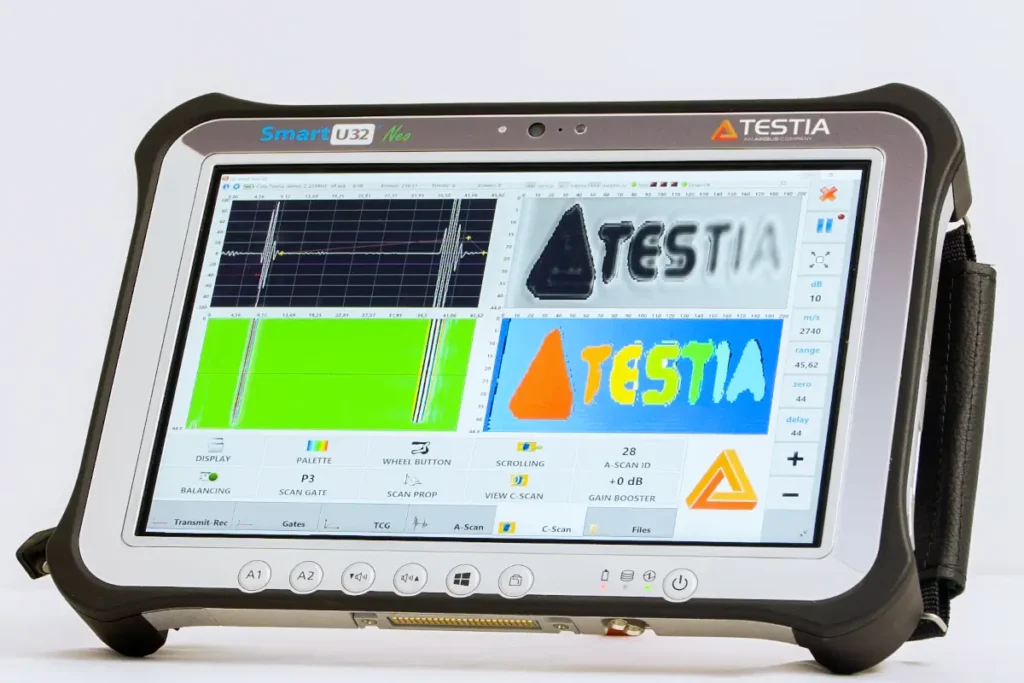
To date, Testia’s active product portfolio includes hardware- and software tools as well as off-the-shelf and customized turnkey inspection systems. “Our inspectors’ feedback, as well as our closeness to our mother company Airbus and its supply chain, are our biggest assets in addressing evolving testing requirements”, Ithurralde says.
Pointing toward Testia’s proprietary Smart UE1 platform and Go/No-Go inspection tools, he highlights how equipment used daily by inspectors across Airbus assembly lines, supplier facilities and aircraft operators helps the wider industry adapt to future requirements.“The aerospace NDT sector is facing a shortage of skilled and certified technicians. With our solutions, we strive to help mitigate the effects of this labor shortage.” Smart inspection tools, Ithurralde says, enable the existing professionals to work more efficiently. They may also enable non-certified technicians to safely carry out specific, standardized inspection tasks under predefined conditions, without compromising compliance or safety. This way, operators can deploy broader site personnel to absorb routine workloads and effectively offset local labor shortages.

Delivering excellence behind the scenes to power operational performance
Aerospace regulations mandate that NDT equipment must be periodically verified, calibrated, and maintained to stay compliant. Testia recognized this operational requirement early on, offering periodic verifications as far back as 1999. “Having managed over 2,000 of our own testing devices, we know the time and effort it takes to keep an equipment fleet operational,” explains Nicolas Fournier, Testia’s global Head of Services and Regional Development. “Our daily exposure to real-world inspections also gives us an objective overview of what tools exist and how they perform.”
In 2026, Testia made this expertise directly accessible to the market to help aerospace customers streamline their equipment management. “Taking this task off our customers’ hands removes a major logistical burden for them,” he explains. “At the end of the day, aerospace is all about precision, predictability, safety – and, ultimately, excellence. As a service partner, our goal is to support our clients in achieving this excellence by making sure they have the tools they rely on at their disposal at any time.” A key milestone in this regard is a seven-year contract awarded by the DMAé (French aeronautic maintenance department). Here, Testia provides maintenance in operational condition and periodic verifications for over 2,200 pieces of NDT equipment used by the French Air and Space Force, Army, and Navy.
Supporting critical industries through future challenges
“Testia has been part of aerospace for 35 years,” says CEO Emmanuel Bodin. “Operating in this environment leaves no room for compromise on precision and safety. Over the decades, Testia has brought that same level of scrutiny to other industries where failure is not an option. That means looking beyond the component itself to understand each customer’s broader operational realities and challenges – and providing end-to-end support at every step”.

This approach remains essential as inspection demands evolve. As Bodin puts it: “We look forward to continuing this journey with our partners and clients. Whether adopting advanced materials or automated testing, our focus does not change: we continue to deliver the end to end absolute reliability they expect from us.”